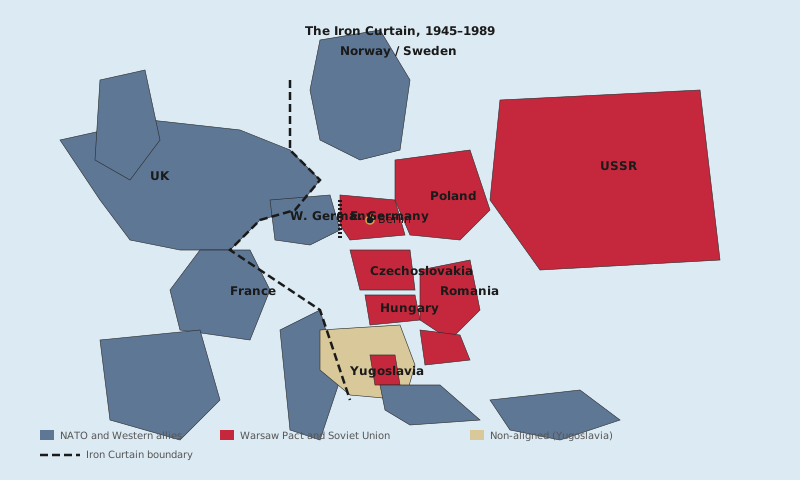
Few phrases in modern political vocabulary did as much work as “Iron Curtain.” Winston Churchill coined it as a metaphor on March 5, 1946, in a speech at Westminster College in Fulton, Missouri. Within months it had become the controlling image of the early Cold War. By the time the Berlin Wall fell on November 9, 1989, the phrase described a real, fortified system of border installations that ran more than 7,000 kilometers across the European continent and had killed an estimated 1,000 or more people attempting to cross it.
From Metaphor to Border Regime
Churchill was not in office when he delivered the Fulton address. He had lost the July 1945 British general election to Clement Attlee and was touring the United States as a private citizen. President Harry Truman, who had been born in Fulton, introduced him. The speech’s most quoted passage came in its central section:
From Stettin in the Baltic to Trieste in the Adriatic, an iron curtain has descended across the Continent. Behind that line lie all the capitals of the ancient states of Central and Eastern Europe. Warsaw, Berlin, Prague, Vienna, Budapest, Belgrade, Bucharest and Sofia, all these famous cities and the populations around them lie in what I must call the Soviet sphere, and all are subject, in one form or another, not only to Soviet influence but to a very high and, in many cases, increasing measure of control from Moscow.
Churchill was describing a political reality that the Western powers had been reluctant to name. The Soviet Union had already imposed communist-dominated governments in Poland, Romania, Bulgaria, and Hungary, and was moving toward a similar settlement in Czechoslovakia, where the February 1948 coup would complete the picture. Stalin responded to the Fulton speech with a Pravda interview on March 13, 1946, accusing Churchill of warmongering and supporting fascism. The exchange set the rhetorical terms of the Cold War.
The Physical Border
The metaphor was given physical form over the next fifteen years. The most elaborate section was the inner German border, approximately 1,400 kilometers long, where East Germany built a system of parallel fences, cleared “death strips,” guard towers, bunkers, minefields, and automated firing devices. The final fortification, completed in the 1970s, used some 1.3 million tons of concrete and more than 65,000 kilometers of barbed wire. Orders to use lethal force were explicit; more than 600 people are documented as killed attempting to cross between 1961 and 1989, with the actual total almost certainly higher.
The Berlin Wall, erected by the East German government in the early hours of August 13, 1961, was both the most visible and the most lethal section of the border. It went through four major iterations before 1989, the final being the “Border 75” system of L-shaped concrete segments topped with smooth pipe that were nearly impossible to grip. At least 140 people died trying to cross it, including Peter Fechter, shot in August 1962 and left to bleed out in the no-man’s-land while Western guards watched helplessly.
Czechoslovakia, Hungary, and the Baltic states operated their own, generally less lethal but still deadly border regimes. Yugoslavia, after its 1948 break with Stalin, was a partial exception: its borders were open enough that émigrés and travelers moved with relative freedom, the practical meaning of Tito’s independent communism.
The Crack-Up, 1989
The Iron Curtain’s physical infrastructure began to give way in May 1989, when the reformist Hungarian government began dismantling its border installations with Austria. The Pan-European Picnic on August 19, 1989, organized by Hungarian and Austrian civil society groups at the border near Sopron, let roughly 600 East Germans cross into Austria in a single afternoon. By autumn, East Germans were streaming out through Hungary, Czechoslovakia, and the West German embassies in Prague and Warsaw. The opening of the Berlin Wall on the evening of November 9, 1989 — precipitated by a press conference in which Politburo spokesman Günter Schabowski misspoke about new travel regulations — was the symbolic end. Within a year, the Two Plus Four Agreement (September 12, 1990) cleared the way for German reunification on October 3, 1990. Within two, the Warsaw Pact was dissolved and the Soviet Union itself was on its last legs.
Legacy
The Iron Curtain left a layered legacy. Economically, the central planning systems of the East produced persistent shortages, technological lag, and a measurable gap in living standards that fueled the political opposition that eventually overthrew them. Politically, it defined the European security order for two generations and produced the institutional architecture — NATO, the European Economic Community, the Conference on Security and Cooperation in Europe — that survived it. Memory of the border regimes remains active in European politics, periodically invoked in debates over Russia, migration — the meaning of the postwar settlement.
Key sources
- Norman M. Naimark, The Russians in Germany: A History of the Soviet Zone of Occupation, 1945–1949 (1995)
- Hope M. Harrison, After the Berlin Wall: Memory and the Weight of History (2002)
- Timothy Garton Ash, The File: A Personal History (1997)
- Frederick Taylor, The Berlin Wall: A World Divided, 1961–1989 (2006)