The Berlin Wall fell on the evening of November 9, 1989, in a confusion that almost no one had planned. The East German government had intended to issue a new travel regulation with restrictions; the spokesman who announced it said the rules would take effect “immediately, without delay.” Within hours, tens of thousands of East Berliners were walking through the checkpoints. By the time the Politburo tried to reverse course, it was too late. The structure that had defined Cold War Europe for twenty-eight years had ceased to exist.
Mary Elise Sarotte has spent two decades reconstructing the chain of decisions that produced the result. Her 2014 book The Collapse: The Accidental Opening of the Berlin Wall shows how the November 9 announcement was the unintended consequence of a separate, months-long negotiation over refugee outflows through the West German embassies in Prague and Warsaw. The Wall’s fall, she argues, was the product of a chain of contingent choices — by East German officials, by Helmut Kohl, by George H. W. Bush, by Mikhail Gorbachev — that could have ended otherwise at several points.
The Wall Before the Fall
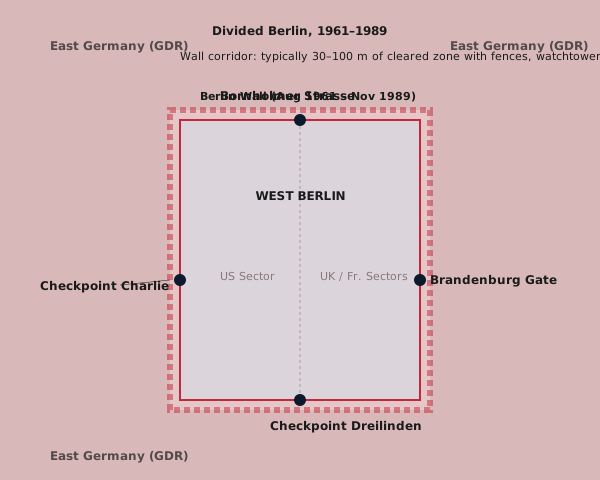
The Wall went up on August 13, 1961. East German leader Walter Ulbricht and the Soviet leadership had watched roughly 3.5 million citizens leave the GDR between 1949 and 1961 — most of them young, educated, and economically active. The sudden closure caught even East German citizens off guard. Streets were cut. Families were separated. Border guards shot at anyone trying to cross. By 1989 the Wall consisted of a roughly 155-kilometer perimeter around West Berlin, including 302 watchtowers, 20 bunkers, 259 dog runs, and a “death strip” up to 100 meters wide. The official East German figure for those killed trying to cross between 1961 and 1989 was 192; the Berlin Wall Memorial’s research puts the total at 140 or more, with the higher count climbing as additional cases are documented.
The Wall was not the border. The border ran the full 1,393 kilometers between the two Germanys, fortified with minefields, watchtowers, and self-shot triggers. But the Wall in Berlin was the most visible symbol of the division. It was where the Cold War showed its teeth.
The Crisis of 1989
By the summer of 1989 the East German regime was running out of time. Hungary had begun cutting the fence on its Austrian border in May; the Pan-European Picnic at Sopron on August 19 let roughly 600 East Germans cross into Austria and onward to the West. Czechoslovakia, still closed, nonetheless became a transit route as East Germans fled into the West German embassy in Prague. By September 30 the embassy was holding some 4,000 people camped in the garden; the West German foreign minister, Hans-Dietrich Genscher, climbed a balcony that night to tell them they were free to leave.
The Honecker regime’s response made matters worse. Erich Honecker, the East German leader since 1971, had ordered a security crackdown and prepared a Chinese-style option for the Monday demonstrations in Leipzig, which had grown from a few thousand in September to 70,000 on October 9. The order to fire was reportedly withdrawn only when the local party chief, Egon Krenz, was told that Soviet forces in the area would not back a massacre. Honecker was forced to resign on October 18. Krenz took over, promised reform, and accelerated the drafting of new travel rules. The Politburo met on the afternoon of November 9 and approved a draft that retained a transitional period with visas and designated crossing points.
Schabowski’s Press Conference
Günter Schabowski, the Politburo spokesman, held a press conference that evening at 6:53 p.m. He read out the text of the new regulation. An Italian journalist, Riccardo Ehrman, asked when the new rules would take effect. Schabowski shuffled his papers, missed the line stating that the regulation would enter into force “on the day of the publication of a corresponding instruction,” and said: “As far as I know — that is immediately, without delay.” The East German news agency ADN issued a brief bulletin. The West German media, watching live, broadcast the answer within minutes. Harald Jäger, the senior officer at the Bornholmer Straße crossing, has described what happened next: crowds gathered, the officers on the ground called superiors for guidance, no clear answer came, and at 11:30 p.m. Jäger gave the order to open the gates. Within an hour, the Wall was being chipped at with hammers.
The scenes that followed — East and West Berliners climbing onto the Wall, drinking champagne, weeping and embracing — were broadcast live around the world. The Wall did not fall in the sense of being knocked down. It was opened, and then it was dismantled, piece by piece, over the following months. Most of the physical structure is gone. The Berlin Wall Memorial preserves a 1.4-kilometer stretch at Bernauer Strasse; a longer section near the East Side Gallery is a canvas for murals.
German Reunification
Reunification came faster than almost anyone had expected. Helmut Kohl, the West German chancellor, had been cautious. On November 28, 1989 he made his Ten Points speech to the Bundestag, proposing a slow transition through confederation. The East German government’s collapse — Hans Modrow’s reformist cabinet lasted barely two months — and the Volkskammer elections of March 18, 1990, won by Kohl’s Alliance for Germany, pushed the timetable forward. The economic union of the two states came on July 1, 1990. The currency union introduced the Deutsche Mark in the East at parity, an act of generosity that economists later judged both politically necessary and economically ruinous: roughly equal to converting East German wages at a rate the East German economy could not sustain.
The external settlement came in the Two Plus Four Agreement, signed in Moscow on September 12, 1990. The signatories were the two Germanys and the four wartime powers: the United States, the Soviet Union, the United Kingdom, and France. Germany confirmed its post-1945 borders, renounced nuclear, biological, and chemical weapons, agreed that NATO would not deploy the integrated military structure into the former East Germany, and committed to a Soviet troop withdrawal by 1994, completed at a cost to Germany of roughly 12 billion Deutsche Mark. Formal reunification took effect on October 3, 1990.
Why the Wall Fell
Five forces converged. The first was the economic failure of the East German regime, which by 1989 could not keep pace with the West. The second was the demographic hemorrhage: between January and November 1989 roughly 200,000 East Germans left the country, mostly young, mostly through Hungary. The third was the example set by the Polish and Hungarian transitions. The fourth was Gorbachev’s repudiation of the Brezhnev Doctrine. The fifth was the cumulative weight of the Monday demonstrations and the Monday prayer meetings in Leipzig that began in September 1982 and continued, week after week, until the regime collapsed.
Any of the first four could have been contained. The fifth, the refusal of ordinary citizens to stay at home, is the one that could not.
Lasting Significance
The Wall’s fall did not just reunify a city. It closed the Second World War. In October 1990 the four-power status of Berlin — the formal legal structure that had governed the city since 1945 — was extinguished. The city became the capital of a reunified Germany, and later, in 1999, the seat of the Bundestag. Germany recovered the lands east of the Oder-Neisse line, but for the rest — East Prussia, Silesia, Pomerania — renounced all claim. The Potsdam settlement of 1945 held.
The cultural aftermath is harder to measure. The physical gap in the city has been filled in, but the social and economic gap between the former East and West has been more durable. Average wages in eastern Germany remain roughly 80–85 percent of western levels; productivity is lower; many young people have moved west. The federal Solidaritätszuschlag — a “solidarity surcharge” income tax, originally introduced in 1991 and not fully phased out until 2021 — funded the rebuilding.
For Europe as a whole, the meaning was simpler. The division that had produced two armies facing each other across a divided continent was over. The European project, until then a Western club, could begin to expand eastward. The path was uneven, and it is not finished. The 2022 Russian invasion of Ukraine has made the post-1989 European security order a contested inheritance. The Wall is gone; the questions it raised about Europe’s organization are not.
Key dates, 1989
| Date | Event |
|---|---|
| 1989-05-02 | Hungary begins dismantling its border fence with Austria. |
| 1989-08-19 | Pan-European Picnic at Sopron lets hundreds of East Germans cross into Austria. |
| 1989-10-18 | Erich Honecker resigns; Egon Krenz succeeds as East German leader. |
| 1989-11-09 | Günter Schabowski’s press conference announces new travel rules “immediately, without delay”; the Wall is opened. |
| 1989-11-10 | The Brandenburg Gate is opened to foot traffic. |
| 1990-03-18 | First free Volkskammer elections in East Germany, won by Kohl’s Alliance for Germany. |
| 1990-09-12 | Two Plus Four Agreement signed in Moscow, settling the external terms of reunification. |
| 1990-10-03 | German reunification takes effect. |
Key sources
- Mary Elise Sarotte, The Collapse: The Accidental Opening of the Berlin Wall (Basic Books, 2014). The definitive account of the autumn of 1989.
- Mary Elise Sarotte, Not One Inch: America, Russia, and the Making of Post-Cold War Stalemate (Yale University Press, 2021). The best single treatment of the diplomacy of German reunification and NATO expansion.
- Frederick Taylor, The Berlin Wall: A World Divided, 1961–1989 (HarperCollins, 2006). A vivid narrative history.
- Hans-Hermann Hertle and Maria Nooke, eds., The Day the Wall Fell: 30 Years On (Hoffmann und Campe, 2019). Useful oral history and documentation from the curators of the Berlin Wall Memorial.