For thirteen days in October 1962 the United States and the Soviet Union stood closer to nuclear war than at any moment before or since. The crisis has been reconstructed, debated, and declassified more thoroughly than almost any other event of the Cold War, and the documents keep producing surprises: in 2002, an ex-CIA officer revealed that Soviet submarines carrying nuclear torpedoes had been driven to the edge of launching in the Sargasso Sea on October 27. The crisis did not end well by accident. It ended because a small number of men made specific decisions under specific conditions.
Background
Three contexts fed into October 1962. First, the failed Bay of Pigs invasion of April 1961 had pushed Havana into Moscow’s arms, Stationing of Soviet troops, then of Soviet missiles, was a direct consequence. Second, the strategic balance was sharply asymmetric: the U.S. had intermediate-range Jupiter missiles in Turkey and Italy aimed at Soviet cities; the USSR had no comparable forward position. Khrushchev’s plan to correct that asymmetry, and to defend Cuba, led to Operation Anadyr and the secret deployment of SS-4 medium-range and SS-5 intermediate-range ballistic missiles. Third, the Vienna Summit of June 1961 had gone badly for Kennedy. Khrushchev walked away believing the young American president was inexperienced and could be pressured. That misjudgment mattered on October 27.
Discovery and ExComm
The first hard evidence came on October 14, 1962, when a U-2 piloted by Major Richard Heyser photographed the construction of an SS-4 launch site near San Cristóbal, western Cuba. Analysts at the National Photographic Interpretation Center confirmed the finding on October 15. Kennedy was briefed on October 16, and he convened the Executive Committee of the National Security Council (ExComm), a body that grew to include, at various points, the Vice President, the Secretaries of State and Defense, the National Security Adviser, the Joint Chiefs, the Director of Central Intelligence, and a handful of senior aides. The transcripts of those meetings, declassified in the 1990s, remain the core source for the crisis.
The Joint Chiefs and some civilian hawks favored an air strike followed by invasion. Air Force Chief of Staff Curtis LeMay predicted the strikes would be a “slam dunk.” The Chiefs produced estimates of low U.S. casualties; Robert McNamara and the CIA judged them as wishful thinking. The blockade option, originally floated by McNamara and Ted Sorensen, was adopted. The word “quarantine” was chosen to avoid the legal implications of “blockade,” an act of war.
Thirteen days
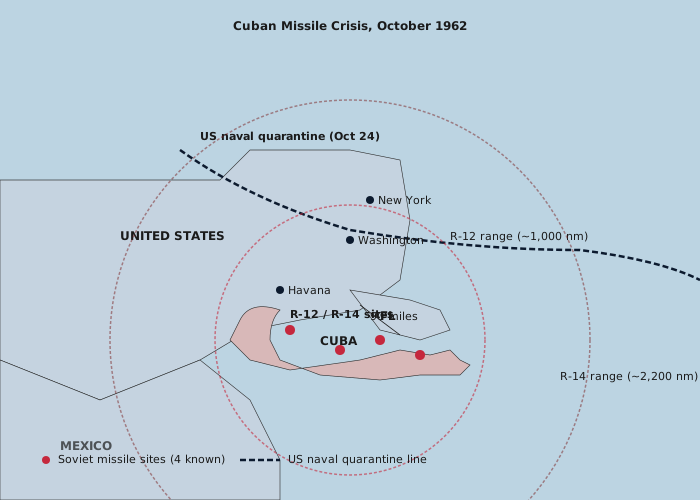
Kennedy announced the quarantine on the evening of October 22. The quarantine line was enforced from October 24, initially 800 nautical miles around Cuba, by 180 U.S. Navy ships, supplemented by reconnaissance aircraft and submarine surveillance. Most Soviet ships turned back; the tanker Bucharest reached the line on October 24 and was allowed through after consultation with Moscow. No shots were fired at sea. The Soviet work on the missile sites, however, continued throughout the crisis; the launchers were not yet operational, but the construction crews were racing to make them so.
October 27 — Black Saturday — was the most dangerous day. A U-2 was shot down over eastern Cuba; the pilot, Major Rudolf Anderson Jr., was killed. A U.S. U-2 accidentally strayed into Soviet airspace over Siberia and was nearly intercepted. In Cuba, an American-backed exile commando raid was beaten back. In the Sargasso Sea, the Soviet submarine B-59, with a nuclear-tipped torpedo on board, was being depth-charged by U.S. destroyers; officer of the watch Valentin Savitsky reportedly ordered the torpedo prepared for launch, and was overruled by brigade chief of staff Vasili Arkhipov, the single decision that may have averted nuclear war on that day. For the crisis that brought the world to this edge, see the Manhattan Project and the atomic bomb.
Khrushchev’s first letter, received on the morning of October 26, offered to trade the missiles for a public no-invasion pledge. The second letter, received on the afternoon of October 27, added the demand that American Jupiters be removed from Turkey. Kennedy accepted the first letter publicly and the second in a private assurance delivered by Robert Kennedy to Soviet ambassador Anatoly Dobrynin. Khrushchev announced the Soviet withdrawal on Radio Moscow on October 28. The missiles were gone by mid-November. The Jupiter withdrawal was completed by April 1963, quietly, and not announced as a trade.
Key dates, October 1962
| Date | Event |
|---|---|
| October 14 | U-2 photographs SS-4 site near San Cristóbal, western Cuba |
| October 15 | National Photographic Interpretation Center confirms the find |
| October 16 | Kennedy briefed; first ExComm meeting |
| October 22 | Kennedy’s televised address; naval quarantine announced |
| October 24 | Quarantine goes into effect; first Soviet ships turn back |
| October 26 | Khrushchev’s first letter: missiles for no-invasion pledge |
| October 27 | U-2 shot down (Major Rudolf Anderson killed); Khrushchev’s second letter adds the Turkey demand; Soviet submarine B-59 standoff in the Sargasso |
| October 28 | Khrushchev announces withdrawal on Radio Moscow |
| November 11 | Soviet Ilyushin Il-28 bombers removed |
| Mid-November | Last Soviet missiles leave Cuba |
| April 1963 | U.S. Jupiter missiles quietly removed from Turkey |
Aftermath
The crisis produced a period of relative Soviet retreat and a period of intensive U.S.-Soviet institution-building. The Moscow–Washington hot line, technically a teletype link, was established in 1963. The Limited Test Ban Treaty was signed in Moscow in August 1963. The Non-Proliferation Treaty, opened for signature in 1968, was a direct legacy, as was the entire SALT process. McNamara’s 1962 Ann Arbor speech, in which he declared that the U.S. would not use nuclear weapons except in response to a nuclear attack, is often read as a conversion that began in ExComm. For the U.S. the memory of October 1962 permanently changed civil defense policy: schools ran “duck and cover” drills; fallout shelters were stocked; the Cuban experience hardened a generation of strategists, including Robert McNamara and Paul Nitze, against the assumption that nuclear war could be limited. The strategic lesson, the rest of the Cold War would repeat, is that escalation is hard to control and that brinksmanship has a survivability limit that no one can compute in advance.
Key sources
- Graham T. Allison, Essence of Decision: Explaining the Cuban Missile Crisis (Little, Brown, 1971)
- Lawrence Freedman, Kennedy’s Wars: Berlin, Cuba, Laos, and Vietnam (Oxford University Press, 2000)
- Timothy Naftali and Philip Zelikow, eds., The Presidential Recordings: John F. Kennedy, The Great Crises (Norton, 2001)
- Michael Dobbs, One Minute to Midnight: Kennedy, Khrushchev, and Castro on the Brink of Nuclear War (Knopf, 2008)
- Serhii Plokhy, The Frontline: Essays on Ukraine’s Past and Present (Harvard Ukrainian Research Institute, 2014) — and his Nuclear Folly: A History of the Cuban Missile Crisis (Norton, 2021) on the Soviet side