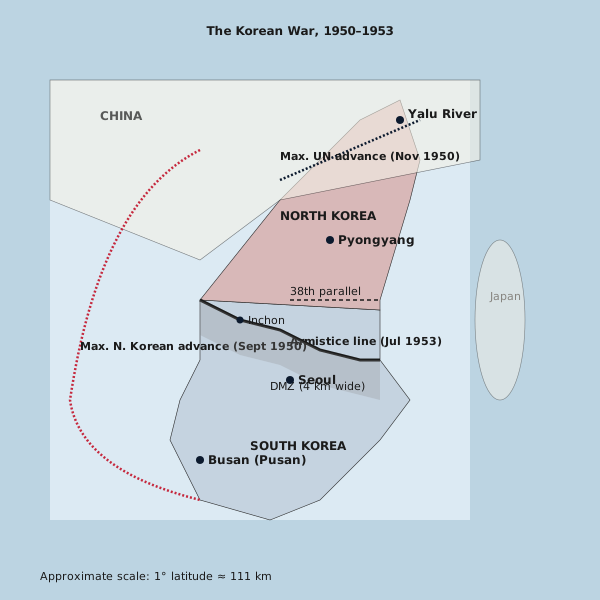
The Korean War was the first major armed conflict of the Cold War and the war that established the precedent that direct superpower confrontation was possible without immediate escalation to nuclear war. Between June 25, 1950 and the armistice of July 27, 1953, roughly 2.5 million Koreans, almost 1 million Chinese, and over 36,000 Americans died, along with smaller contingents from more than twenty other countries serving under United Nations command. The fighting ended where it began, near the 38th parallel — the border it fixed is still in place.
Origins
Korea had been a Japanese colony from 1910 to 1945. The Soviet Union and the United States accepted Japanese surrender in August 1945 by dividing the peninsula at the 38th parallel, an administrative expedient that hardened into a political boundary. Two rival states emerged in 1948: the Republic of Korea in the south under Syngman Rhee, a conservative nationalist who had spent decades in the United States, and the Democratic People’s Republic of Korea in the north under Kim Il-sung, a former anti-Japanese guerrilla commander who had fought with the Soviet Red Army.
Kim Il-sung pressed Stalin for permission to invade the south as early as 1949. Stalin hesitated. He worried about American reaction and about the readiness of the North Korean army, which had been weakened by the loss of many Korean officers to Soviet-backed purges. The decisive shift came in early 1950, after Mao’s victory in China gave the communist bloc a continental depth that Stalin had previously lacked. The cable of approval, sent through the Soviet embassy in Pyongyang, authorized Kim to proceed on the understanding that the attack would be swift and would present the United States with a fait accompli.
William Blum, in Rogue State (2000), and William Stueck, in The Korean War: An International History (1995), have both argued that the war cannot be understood without taking seriously the North Korean and Chinese motivations, not just the American response. Stueck in particular documents how Stalin and Mao initially treated the project as a Korean affair and only became directly engaged after the United Nations intervened.
The war
The North Korean People’s Army struck on June 25, 1950 with around 90,000 troops, more than 150 Soviet-built T-34 tanks, and full air support. Seoul fell in three days. The South Korean army, under-equipped and poorly led, collapsed back toward the southeastern corner of the peninsula, where it joined American and other UN forces in a shrinking perimeter around the port of Pusan.
The United Nations Security Council authorized the use of force on June 27, 1950. The vote was possible only because the Soviet delegate was absent, a boycott that followed the Council’s refusal to seat the new People’s Republic of China. Had the Soviet Union been present, the resolution would have been vetoed. The Truman administration committed ground forces within days and appointed General Douglas MacArthur to command them.
The war’s turning point came on September 15, 1950, with MacArthur’s amphibious landing at Inchon, deep behind the North Korean lines. The landing severed the North Korean supply lines, broke the siege of Pusan, and put UN forces in position to drive north. By October 1950, UN troops had retaken Seoul and crossed the 38th parallel. MacArthur’s stated objective became the unification of Korea under non-communist rule.
Beijing had warned, in a series of public statements, that it would not tolerate UN forces on its border. On October 25, 1950, after MacArthur pushed toward the Yalu River, the Chinese People’s Volunteer Army — at least 200,000 troops in the first wave — entered the war. The Chinese intervention drove UN forces back below the 38th parallel by January 1951 and produced a war of movement that settled, by mid-1951, into a stalemate roughly along the line that would eventually become the demarcation boundary.
Stalemate and armistice
Two years of attritional fighting followed. The front shifted by no more than a few miles in either direction at any point. The war was decided at the negotiating table at Panmunjom, beginning in July 1951. The central disputes were the location of the demarcation line and the question of voluntary repatriation of prisoners of war, the latter complicated by the fact that many North Korean and Chinese POWs did not wish to return.
The fighting ended with the signing of the Korean Armistice Agreement on July 27, 1953. The agreement established the Military Demarcation Line and the Korean Demilitarized Zone, a buffer roughly 4 kilometers wide running 250 kilometers across the peninsula. It did not end the state of war; that has required only a peace treaty, which has never been signed. The United States and the Republic of Korea signed a bilateral Mutual Defense Treaty in October 1953, which remains in force.
Why the war mattered
The Korean War changed the Cold War. It demonstrated that the United States would fight a major land war in Asia rather than accept a communist victory anywhere on the continent. It produced a threefold expansion of the American defense budget, the permanent stationing of U.S. forces in South Korea, and the incorporation of West Germany into NATO in 1955. It also produced the dismissal of MacArthur by President Truman in April 1951, after MacArthur publicly demanded escalation. The dismissal reasserted civilian control of the military at exactly the moment nuclear weapons were becoming central to American strategy.
The war was devastating for Korea as a country. Northern cities were reduced to rubble by American bombing; southern villages were swept repeatedly by ground combat. The peninsula’s GDP did not recover its 1950 level for two decades. For the United States, the war settled the question of containment in Asia, but at a cost that made the country wary of another land war there for the next fifteen years — a wariness that did not survive Vietnam.
Key sources
- William Stueck, The Korean War: An International History (Princeton, 1995)
- William Blum, Rogue State: A Guide to the World’s Only Superpower (Common Courage, 2000)
- John Lewis Gaddis, The Cold War: A New History (Penguin, 2005)
- Odd Arne Westad, The Cold War: A World History (Basic Books, 2017)