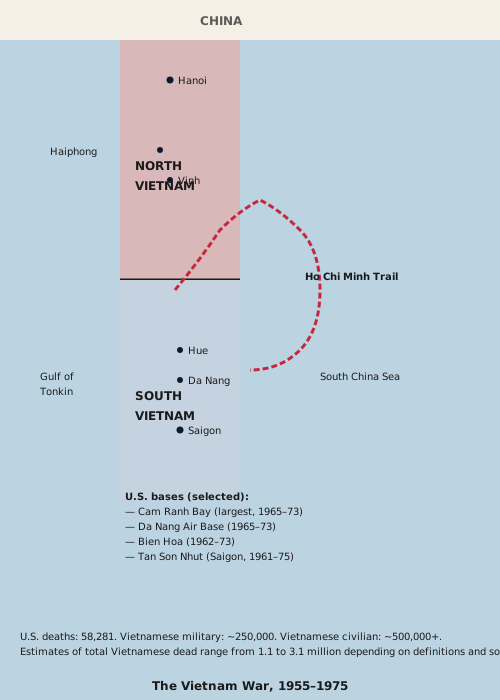
The Vietnam War was the longest American military conflict of the twentieth century and the one that did the most to break the domestic consensus on containment. Between the arrival of the first U.S. military advisors in the early 1950s and the fall of Saigon on April 30, 1975, the war killed more than 58,000 Americans, an estimated 250,000 South Vietnamese soldiers, between 500,000 and 1 million North Vietnamese regulars, and somewhere between 1.5 and 3 million Vietnamese civilians. It also killed several hundred thousand Laotians and Cambodians in wars that the American intervention in Vietnam made possible. It ended in the unification of Vietnam under communist rule.
Origins
Vietnamese communism predated the Cold War. Ho Chi Minh founded the Indochinese Communist Party in 1930 and led the Viet Minh, a broad nationalist front, against both the Japanese occupation and the return of French colonial rule after 1945. The First Indochina War ended with the French defeat at Dien Bien Phu in May 1954 and the Geneva Accords of July 1954, which divided Vietnam at the 17th parallel and called for nationwide elections in 1956 to reunify the country.
Ngo Dinh Diem, the U.S.-backed prime minister and later president of South Vietnam, refused to allow the elections. With the support of the Eisenhower administration, he calculated — probably correctly — that Ho Chi Minh would win any genuinely contested ballot. The noncommittal government in the south hardened into an American client state — the indigenous southern communist insurgency, the Viet Cong, grew in response to Diem’s brutal rule.
American involvement deepened across the late 1950s. The number of U.S. military advisors grew from a few hundred in 1955 to over 16,000 by late 1963. The Kennedy administration backed the November 1963 coup that overthrew and killed Diem, hoping for a more stable government, but the political situation in Saigon deteriorated into a series of coups. The Gulf of Tonkin incidents of August 1964 — a North Vietnamese patrol boat attack on the destroyer Maddox on August 2 and a claimed but disputed second incident two days later — gave President Lyndon Johnson the congressional resolution he used to justify major escalation. The resolution passed the House 416 to 0 and the Senate 88 to 2 on August 7, 1964.
Fredrik Logevall’s Choosing War (1999) argues persuasively that Johnson had decided on large-scale American combat involvement well before Tonkin, and used the incidents as a public pretext. Logevall shows that the administration’s calculations were not driven primarily by the global balance of power but by the political risk of being seen to lose Vietnam.
The American war
The first U.S. combat units landed at Da Nang on March 8, 1965. By the end of that year, more than 180,000 American troops were in Vietnam; by 1968, more than 500,000. The American strategy combined conventional operations, search-and-destroy missions against Viet Cong main force units, strategic hamlet program aimed at separating the rural population from the insurgency. All three failed. The Viet Cong’s strength lay in the villages, and the American approach, dependent on firepower and body counts, drove peasants toward the insurgents even when it failed to kill them.
The war’s military turning point was the Tet Offensive, launched on January 30, 1968. Viet Cong and North Vietnamese units attacked more than 100 cities and military installations, including the U.S. embassy compound in Saigon. The offensive was a tactical defeat for the communists, who lost perhaps 50,000 killed and failed to hold any of their objectives. It was, however, a strategic catastrophe for the American position, because it demolished the official narrative that the war was being won. Walter Cronkite’s February 1968 broadcast after visiting Vietnam — “What seems clear is that the war is at a stalemate” — marked the moment the American middle class concluded the war could not be won.
Johnson announced on March 31, 1968 that he would not seek re-election. The Paris Peace Accords, signed in January 1973 by the United States, North Vietnam, South Vietnam, and the Provisional Revolutionary Government of the Viet Cong, provided for a ceasefire and the withdrawal of American forces. They did not provide for the withdrawal of North Vietnamese troops already in the south, and the U.S. Congress, in the Case-Church Amendment of June 1973, cut off further military funding for South Vietnam.
The fall
President Richard Nixon’s policy of “Vietnamization” — the transfer of combat responsibility to the South Vietnamese army — had bought time but not a durable equilibrium. The South Vietnamese economy was hollowed out by corruption, the desertion rate among draftees was catastrophic, and North Vietnam’s logistics had been rebuilt in the years after Tet. The Politburo in Hanoi decided in late 1974 to authorize a general offensive.
The North Vietnamese attack began in March 1975 against the Central Highlands. The South Vietnamese army collapsed in days. Hue fell on March 22, Da Nang on March 30. By mid-April, the North Vietnamese were shelling the runways of Tan Son Nhut airport in Saigon. Congress refused to grant the emergency aid President Ford requested. The U.S. evacuation, Operation Frequent Wind, began on April 29; North Vietnamese tanks crashed through the gates of the Presidential Palace the following morning.
Aftermath
The fall of Saigon ended the war but did not produce a peace. Vietnam, Cambodia, and Laos entered difficult transitions. The Khmer Rouge took Phnom Penh on April 17, 1975 and began the killing fields that killed roughly 1.7 million Cambodians over the next four years. Vietnam invaded Cambodia in December 1978 to remove the Khmer Rouge, and the Sino-Vietnamese War of February–March 1979 followed within weeks, with China punishing Vietnam for its alignment with Moscow. The United States imposed a trade embargo on Vietnam that lasted until 1994, and full diplomatic relations were not normalized until 1995.
For the United States, the war produced the War Powers Resolution of November 1973, the only major constraint on presidential warmaking enacted over a presidential veto, and a generation of policymakers shaped by the lesson that American public opinion would not tolerate long deployments in Asia. That lesson lasted through the 1990s and into the 2000s, and arguably shaped the American approach to the post-9/11 wars in Iraq and Afghanistan.
Key sources
- Fredrik Logevall, Choosing War: The Lost Chance for Peace and the Escalation of War in Vietnam (University of California Press, 1999)
- Lien-Hang T. Nguyen, Hanoi’s War: An International History of the War for Peace in Vietnam (University of North Carolina Press, 2012)
- Mark Atwood Lawrence, The Vietnam War: A Concise International History (Oxford, 2008)
- Odd Arne Westad, The Cold War: A World History (Basic Books, 2017)